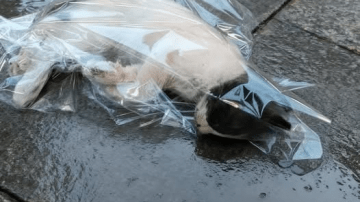
The small, brindle dog, later named Justice by his rescuers, was barely clinging to life. His emaciated body, covered in scars and the ragged remains of a homemade muzzle, lay motionless on the cold clinic blanket. For years, he had endured a private hell, suffering consistent, brutal abuse at the hands of the very man who was supposed to care for him. The final, unimaginable act was an attempt to bury him alive—a horrific crime that left the entire neighborhood reeling. Yet, when the abuser faced the court, the outcome was an infuriating twist: a slap on the wrist, a paltry sentence of community service. The injustice hung heavy in the air, a thick, suffocating blanket of betrayal, prompting hushed and angry conversations on every street corner. This failure of the system was the last straw for one local resident, a former Marine named Alex Thorne, whose quiet rage had reached its boiling point. He had watched the dog’s suffering from a distance, helpless to intervene legally, but now, he felt an undeniable call to action—a debt owed to an innocent creature who couldn’t fight for himself.

Thorne didn’t waste time on planning. Fueled by a raw, righteous anger, he walked directly to the abuser’s dilapidated house. His movements were deliberate, his gait military-precise, a stark contrast to the churning storm of emotion inside. He found the man preening on his front porch, seemingly unbothered by the life he had nearly extinguished, a grotesque picture of smug impunity. Without preamble, Thorne delivered his challenge, his voice low and guttural: “Try picking on someone who can fight back.” The abuser, initially confused and dismissive, barely had time to register the shift in the air before the first blow landed. This was not a fair fight; it was a reckoning. Thorne, hardened by years of training and now driven by a powerful moral imperative, unleashed a calculated fury. The fight was over in mere moments, a brutal, sudden explosion of justice dealt outside the confines of law.

The unexpected twist arrived with the sound of distant sirens. The abuser lay moaning on the uncut grass, his brief moment of freedom now violently shattered. The neighborhood, having witnessed the swift, uncompromising confrontation, held its breath, expecting the Marine to flee. Instead, they watched as Thorne calmly dusted off his hands, the crimson smear across his knuckles a silent testament to the fight. He stood there, legs braced, waiting for the police. When the officers arrived, they found a scene that defied expectations: the victim of the assault was the same man who had brutalized an animal, and his attacker was a man of quiet conviction, utterly at peace with his actions. Thorne offered no resistance, no excuse. As the cold metal of the handcuffs clamped down, a wide, genuine grin—not of malice, but of profound satisfaction—stretched across his face.

The Marine’s brief exchange with the arresting officers captured the essence of his motivation. When asked why he had chosen to abandon his restraint and risk everything, his reply was starkly simple, echoing a code that transcended legal boundaries: “Dogs deserve defenders too.” His mugshot, taken shortly thereafter, quickly circulated online, showing not the shame of a criminal, but the fierce, triumphant smile of a man who had done the right thing, regardless of the personal cost. Meanwhile, the small, beaten dog, Justice, was finally receiving the care he desperately needed, whisked away to a loving rescue facility where the true process of healing—both physical and psychological—could finally begin.

The final, lasting twist in this dramatic saga involved the abuser. Facing public scrutiny and the cold reality of Thorne’s vigilante justice, the man quietly and swiftly packed his belongings and vanished from the town. He never returned, his presence eradicated by a single, decisive act of defiance. The Marine, though facing legal repercussions, became an instant, unofficial local hero—a testament to the power of standing up against cruelty when the system fails. His actions served as a harsh, visceral warning: some injustices will not be ignored, and some creatures will not be left to suffer alone.