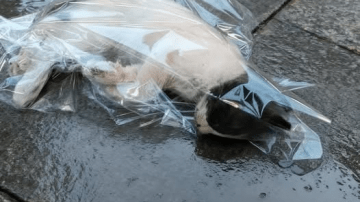
The air hung heavy and thick with the scent of decay, a suffocating tapestry woven from discarded refuse and forgotten dreams. It was here, in the grim landscape of the city’s main landfill, that a glimmer of white caught the eye of a sanitation worker named Elias. Initially, he dismissed it as another piece of bleached refuse, but the stillness of the form, unnaturally poised amidst the rubble, compelled him to look closer. What he found sent a sharp jolt of shock and pity through him: a medium-sized dog, its once-pristine white coat now stained with grime and exhaustion. The dog sat huddled on a mound of splintered wood and broken bricks, its gaze distant and weary. Most heartbreakingly, its rear left leg and a portion of its abdomen were crudely wrapped in dirty, makeshift bandages—strips of what looked like torn cloth and plastic, caked with dirt and perhaps old blood. This image, stark against the backdrop of human waste, underscored a painful truth: dogs need our love and care, particularly during illness or when they face abandonment, and this loyal companion had clearly faced both. Elias, a man hardened by years of dealing with the city’s detritus, felt an unexpected, visceral pull toward the creature. He knew he couldn’t leave it. The dog, which he would later name Ghost for its spectral color and silent demeanor, was a testament to suffering and resilience, waiting for a compassion that seemed utterly misplaced in this desolate environment.

Elias’s initial attempts to approach Ghost were met with a low growl, a fearful, almost desperate sound that spoke volumes of past trauma. He tried to offer a piece of his lunch—a dry biscuit—but the dog flinched, pulling its injured leg further beneath its body. The sanitation worker realized this wasn’t a case of simple hunger or fear; there was a deep-seated distrust, a history he couldn’t immediately decipher. He spent the next three days subtly establishing a presence, working in the vicinity, speaking softly, and leaving water a few feet away. On the fourth morning, a sudden, heavy rain began to fall, turning the landfill’s loose soil into a treacherous slurry. Elias watched as Ghost struggled to shift position, the makeshift bandages becoming sodden and heavy, the effort clearly sending tremors of pain through its body. It was an unexpected twist—the harsh weather becoming the catalyst for a breakthrough. Seeing the dog in distress, Elias acted on pure instinct, moving slowly but deliberately, using his jacket as a shield against the rain, and finally managing to gently loop a makeshift lead around Ghost’s neck. The dog, exhausted and defeated by the elements and its injury, offered no resistance.

The first veterinary examination delivered the next shocking twist. The leg wasn’t just injured; it was a complex fracture that had begun to heal improperly. The vet, Dr. Lena Petrova, explained that the crudely applied bandages had surprisingly acted as a rudimentary splint, preventing the bone from fully displacing, which might have necessitated amputation. More astonishingly, nestled beneath the dirty rags, they discovered a small, faded tag sewn into the cloth. The tag, barely legible, bore the name and address of a suburban home miles away from the landfill. This detail shifted the narrative from a simple case of abandonment to a mystery. Had the dog run away after an accident? Or was the injury and the tag’s distance a sign of something more deliberate? The critical importance of showing empathy and taking responsibility was no longer just about rescue; it was about uncovering the truth of Ghost’s ordeal.

Following the lead of the address tag, Elias and Dr. Petrova drove to the quiet, tree-lined street. The house was well-maintained, suggesting a stable, loving environment—the exact opposite of the landfill. The elderly woman who answered the door, Mrs. Eleanor Vance, burst into tears upon seeing the photo of Ghost. Her dog, named Casper, had been missing for over six weeks. Mrs. Vance recounted the most unexpected twist of all: Casper had been hit by a car while chasing a squirrel and, in his panic, had run off into the dense woods nearby. Due to her own mobility issues, she couldn’t search far. She had reported him missing, but all hope was lost. The “abandonment” was a desperate flight after trauma, and the injury was an accident. Even more heartbreakingly, she revealed that the crude bandages were, in fact, strips of a beloved blanket she had made for him, which he had been wearing when he ran off. Casper, injured and lost, had somehow managed to wrap his own wounds with a familiar, comforting scent, a profound act of self-preservation and memory that showcased his incredible loyalty.
The story of Ghost, now happily reunited and recovering as Casper, served as a powerful testament to the necessity of empathy and responsibility. The dog, discovered at a landfill with an injured leg, highlighted the critical importance of looking beyond the surface. What appeared to be a simple case of neglect and dumping turned out to be a tale of a loyal dog’s desperate six-week battle for survival, culminating in a rescue by an unexpected hero, Elias. Casper’s miraculous instinct to use his own blanket to stabilize his injury was a deeply emotional detail that resonated far beyond the confines of the veterinary clinic. His recovery, overseen by Dr. Petrova and supported by Elias who became a regular visitor, was swift and complete. The loyal companion, once lost and injured amidst the rubble, returned to the love and care of his owner, a poignant reminder that every animal’s story is unique, often filled with unseen struggle, and always deserving of our compassion.